
Personality and Intelligence
What are smart people like?

There has long been interest in the link between personality traits and intelligence. Do more intelligent individuals have different personality traits than less intelligent individuals? Can we estimate how smart somebody is based on their personality?
Conceptually, this question is trickier than it sounds. Personality is typically measured with self-report questionnaires. For example, if I want to know whether somebody is high in a trait like openness to experience, I might ask about their interest in complex ideas, philosophy, imagination, aesthetics, and their general curiosity about the world—basically, I want to know their typical pattern of thoughts, feelings, and behaviors that are conceptually related to being open to experience.
When I want to measure intelligence, the approach is different. I don’t ask people to self-report their typical level of intelligence on a scale of 55 to 145 or whatever. Instead, to measure intelligence I am typically giving a test that measures individuals’ performance on a broad range of cognitive abilities—things like vocabulary and verbal skills, quantitative ability, memory, and abstract reasoning—and then estimating a global IQ score.
One reason this is important is that it is much easier to fake a personality test than an IQ test. If I am taking a face-valid Big Five personality test or a Myers–Briggs, for example, I can pretty much make the results look however I want. When I was recently working on the personality questionnaires for the newest edition of our Personality Psychology textbook, I would max out the questionnaire scores to confirm the ranges were correct.
If I am given an IQ test, however, I can’t manipulate the results as much. I can give incorrect answers to items I know (i.e., “fake bad”)—but I cannot simply answer all the questions correctly or incorrectly because I won’t know many of the answers. I wasn’t that smart even when I was young and smart.
The other interesting point about IQ testing is that intelligence can be divided into fluid and crystallized intelligence. Fluid intelligence is about reasoning or problem-solving ability without acquired knowledge, and crystallized intelligence is more about what you know. So if you have read a lot of books and explored a lot of ideas, your crystallized intelligence is likely to benefit.
Over the decades, researchers have conducted many studies in which they administered both personality questionnaires and intelligence tests to the same samples. So, the next research step is easy: you combine all the studies into a single big study, or meta-analysis, and, Bob’s your uncle, you have a robust estimate of the personality profile associated with higher intelligence.

This is basically what happened, but there was a wrinkle to the story.
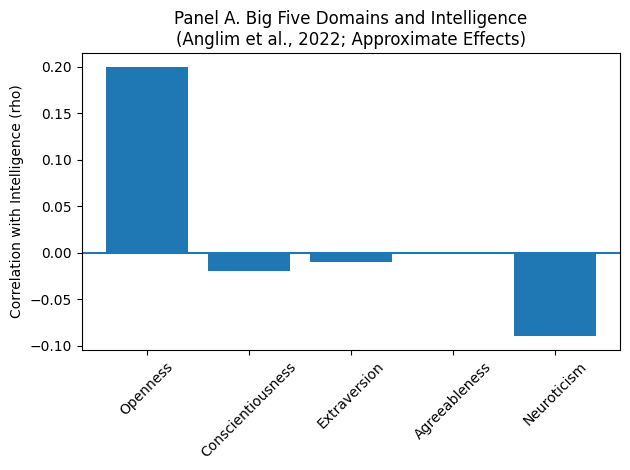
First, researchers did this meta-analysis and found a pretty clear pattern. Intelligence shows its strongest and most consistent positive association with the Big Five trait of openness to experience. The correlation is modest in magnitude, but it is larger than for the other Big Five traits. Neuroticism shows a smaller negative association. conscientiousness, extraversion, and agreeableness are near zero at the broad domain level (see image below).
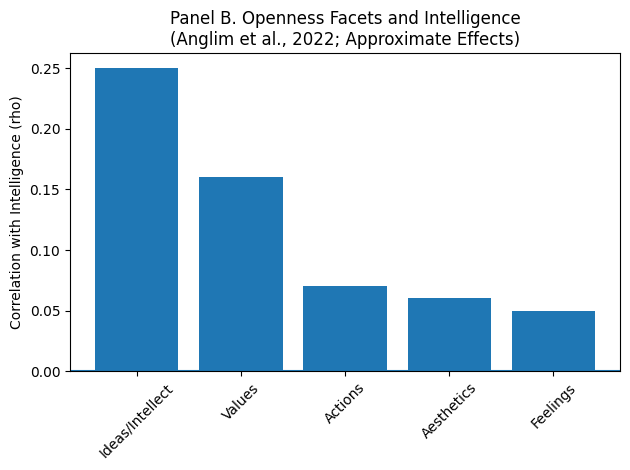
But when you drill down into openness, the story tightens. The association with intelligence is strongest for the intellectual or “ideas/intellect” facet of openness—interest in abstract thinking, complex ideas, and cognitive exploration. Facets that are more purely aesthetic or emotional (i.e., “aesthetics”, “feelings”) show much weaker associations.
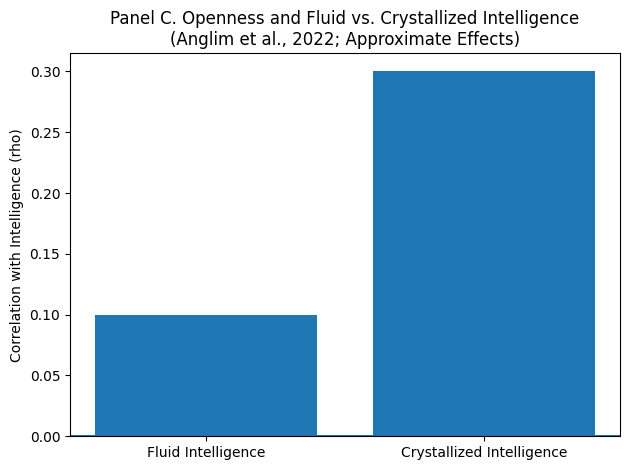
And importantly, openness tends to correlate more strongly with crystallized intelligence—acquired knowledge and verbal competence—than with fluid intelligence, which reflects more abstract reasoning abilities. That pattern is consistent with the idea that intellectually curious people accumulate more knowledge over time.
At this point, the story is fairly clean: intelligence is most closely tied to the intellectual components of openness, modestly and negatively related to neuroticism, and largely unrelated to the other broad Big Five domains.
But then a much larger and more ambitious meta-analytic project by Stanek and Ones (2023, PNAS) complicated the picture. Rather than looking only at broad Big Five domains, they examined personality–ability relations across hierarchical levels—broad traits, aspects, and facets—and across many types of cognitive ability. When you look at more specific personality components, they reported nontrivial associations beyond openness.
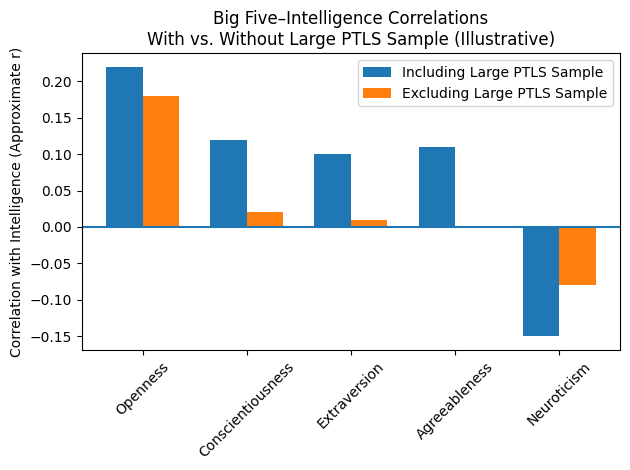
For example, they found associations between intelligence and facets such as industriousness within conscientiousness, compassion within agreeableness, and activity within extraversion. If you look at their database including the very large Project Talent Longitudinal Study (PTLS), some of these correlations are substantial. For example, in their reported estimates including PTLS, C-Industriousness correlates .27 with intelligence, A-Compassion correlates .21, etc. It begins to look less like a narrow openness effect and more like intelligence spreading broadly across personality. It was a much broader model of personality and intelligence than we had before.
However, Lee and Ashton (2025, Journal of Research in Personality) revisited those results and showed that many of the larger and more surprising associations were heavily influenced by the PTLS sample, which includes over 350,000 participants and uses personality measures that do not map cleanly onto modern Big Five constructs. When they recalculated the sample-weighted mean correlations excluding PTLS, the pattern changed dramatically. Once the PTLS sample was removed, the correlations shrank substantially and the overall pattern looked much closer to the earlier literature emphasizing openness (particularly intellectual facets) and a modest neuroticism effect. You can see this pattern clearly below, where the orange bars have a sharper high openness/low neuroticism pattern.
The current debate, therefore, is not about whether personality and intelligence are related—they clearly are—but about how broad and how robust those relations are across well-validated measures.
When you look at people who score relatively high on intelligence tests, what stands out most consistently are aspects of openness related to intellectual curiosity and engagement with complex ideas. Whether you are energized and talkative, like I am, or quiet and reserved, like many academics, does not appear to be meaningfully related to general intelligence at the broad trait level. Same for conscientiousness and agreeableness: they don’t seem that related to intelligence.
Because most of the evidence is correlational, we don’t really know if personality is driving intelligence or vice versa. One plausible interpretation is that individuals who are dispositionally curious and who have access to cognitively enriched environments (like having books around the house) are more likely to engage with those environments. That engagement may facilitate knowledge accumulation, especially crystallized intelligence, creating a feedback loop between curiosity and learning.
This interpretation is consistent with the stronger openness–crystallized intelligence association observed in meta-analytic work, but developmental work is outside my expertise, so I do not want to overstate the case.
The second takeaway, which is a bit more paradoxical, is that the development of intelligence—particularly crystallized intelligence—may require a willingness to tolerate looking foolish. If you always have to be the smartest person in the room you, are not going to grow very much. Intellectual humility accompanies curiosity. The Zen term for this is “beginner’s mind.” There is a dynamic between opening yourself up to seeing the world with fresh eyes, learning what you can, and crystallizing the new knowledge into your worldview. Over time, this crystallized intelligence will ideally alchemize into wisdom.
Links to my work: Homepage; Peterson Academy; Books on Amazon
My New Peterson Academy course: The Psychology of Wealth
My PA Intro to Psych history lecture now on YouTube
Some citations
Anglim, J., Dunlop, P. D., Wee, S., Horwood, S., Wood, J. K., & Marty, A. (2022). Personality and intelligence: A meta-analysis. Psychological Bulletin, 148(5-6), 301–336.
Stanek, K. C., & Ones, D. S. (2023). Meta-analytic relations between personality and cognitive ability. Proceedings of the National Academy of Sciences, 120(23), e2212794120.
Lee, K., & Ashton, M. C. (2025). Personality/cognitive ability relations with and without the project talent longitudinal sample. Journal of Research in Personality, 117, 104624.
Twenge, J. M., & Campbell, W. K. (2020). Personality psychology: Understanding yourself and others. Pearson.
Indeed, and speaking of C and industriousness if I recall well: orderliness is slightly negatively correlated with IQ which could explain the ~0 correlation at the trait level. Most peer-review papers don't include the 10 domains and even less so the 30 facets (because it's difficult/unreliable). But 2 people that score exactly the same at the trait level can still be radically different.
Anyway, intuitively it doesn't make sense that something as central as cognitive ability would only be correlated to 10/30 facets.
it's interesting to note that major historical or intellectual figures might display a very unique psychometric profile, that is, not only very high O and IQ but combined with very high neuroticism (in music or visual art) and/or orderliness like Louis Ferdinant Céline for example.