
Maximizers vs. Satisficers
When the perfect becomes the enemy of the good enough

In the middle of the last century, there was a lot of interest in rational choice and optimal decision-making. Herbert Simon famously countered that rationality in humans needed to be bounded. The number of variables and potential interactions in any decision is too complicated to fully address, so the better option is to search for a good-enough decision, and then accept that. If a better decision comes along later, fine, you move on or stay where you are depending on circumstances.
Simon called this decision-making strategy satisficing. He was making an argument about bounded rationality: humans generally cannot optimize perfectly because real-world decision spaces exceed our cognitive and informational limits. The world is just too complex. So rather than searching forever for the perfect answer, we search until we find an answer that is good enough.
Essentially, Simon was making an argument that sounds a lot like “the perfect is the enemy of the good.” The hunt for perfection is often impossible because we do not have access to all the relevant information, we cannot process every variable, and the world keeps changing while we are trying to decide.

Nearly a half century after Simon made his case for satisficing, psychologist Barry Schwartz and colleagues turned maximizing versus satisficing into a more formal individual-difference construct. They asked whether some people are more maximizers and others are more satisficers. In other words, are some individuals more focused on looking at every possible angle, outcome, and option, while others search until they find something that works well enough and then move on?
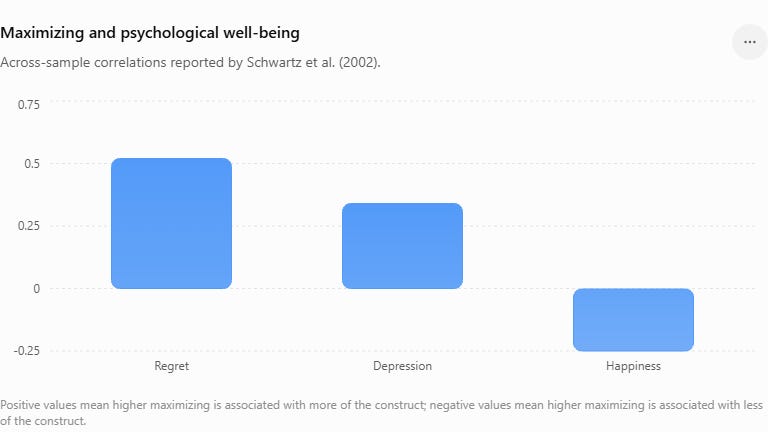
Schwartz and colleagues developed a Maximization Scale, and they measured the association between trait maximizing and psychological outcomes. Maximization included concepts like high standards, alternative search, decision difficulty, and keeping options open. They were interested primarily in decisional regret as an outcome: Do you feel regret over your decisions? They also looked at well-being, measured both negatively as depression and positively as happiness.
Below, you can see some sample items from the Maximization Scale. It’s pretty clear that the scale is picking up something like perfectionism in search. This is not about being a perfect person. It is about trying to make a perfect, very well-reasoned, or best-possibly-reasoned decision.
Whenever I’m faced with a choice, I try to imagine what all the other possibilities are, even ones that aren’t present at the moment.
I’m a big fan of lists that attempt to rank things (the best movies, the best singers, the best athletes, the best novels, etc.).
No matter how satisfied I am with my job, it’s only right for me to be on the lookout for better opportunities.
I treat relationships like clothing: I expect to try a lot on before I get the perfect fit.
As Schwartz and colleagues predicted, the general tendency toward maximizing decisions was not associated with peace and well-being. Instead, maximizing was associated with more regret over decision-making, but also with more depression, as measured by the short form of the Beck Depression Inventory, and lower levels of happiness. So it looks like, in terms of well-being, individuals who maximize rather than satisfice are less happy. Below is a figure I made from the summary correlations reported in the paper.
We can also project this trait of maximization onto the Big Five personality model, or OCEAN. This will help us interpret what is going on. A paper by Purvis and colleagues did this, and the personality profile associated with trait maximizing is generally a little bit less happy of a profile. Maximization is positively associated with neuroticism and negatively associated with conscientiousness and agreeableness in the zero-order correlations, with neuroticism being the standout across samples. In the regression models, neuroticism emerged as the strongest predictor of overall maximization. (Figure below with data from the paper made by me).
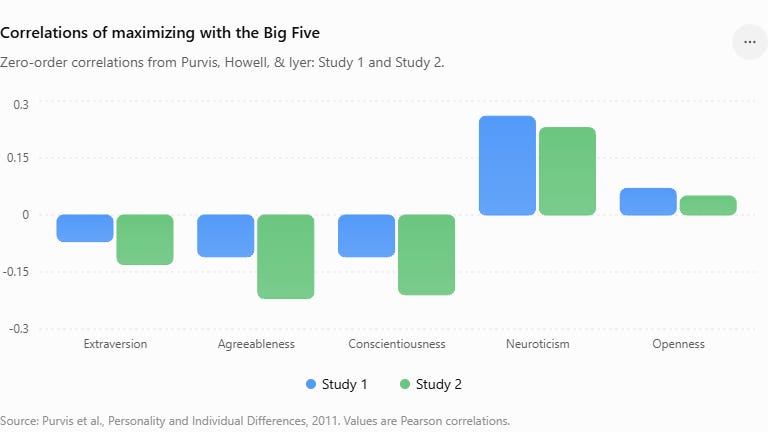
This is interesting because what it suggests is that maximizing decisions isn’t so much about being careful, or being disciplined, which you would expect if maximization were mainly about high conscientiousness. Instead, much of the maximizer profile seems to be about neuroticism and regret: not wanting to make a mistake, not wanting to feel stupid, and not wanting to look back and feel that you chose poorly. So, extrapolating a bit, maximizing is more about not being wrong than about being right.
There is some nuance here. There are some subfactors of maximization that researchers are starting to look at. For example, people who have high standards for themselves when making decisions are more likely to be conscientious even as they maximize. So I am presenting the basic pattern of findings—high levels of maximizing are associated with higher regret and trait neuroticism and lower well-being—but there are some more complex models of maximizing and satisficing being developed that yield more complicated results.
But the general takeaway from all this is that decision-making under uncertainty is really challenging. It is basically beyond human capacity to make decisions perfectly, and so we have to find that point where we just go for it. Satisficing isn’t perfect, but decisive action feels good.
Martin Buber, the existential philosopher, once said something like, “Evil is like a whirlwind, and good is like a direction.” (Note: I cannot find the quote. AI says I am making it up. I read Buber as an undergraduate, so who knows, but I like it anyway). There are many layers to this, but one broad interpretation is that we were put on this earth to struggle, act imperfectly, and sometimes fail, rather than be paralyzed by indecision and regret.
So, I generally like Simon’s model of bounded rationality. Effortful and thoughtful decision-making has the benefit of mapping out the problem before you. This helps with learning over time because you can study your decision-making style and ideally improve it. It also allows you to show and defend your decision-making style to others. But getting caught in a cycle of “analysis paralysis” probably won’t help the quality of your decisions and definitely won’t feel good.
Recent podcasts: Paradox Press on Narcissism and spirituality
Recent Articles: Narcissism, Spirituality and Ego Inflation
Links to my work: Homepage; Peterson Academy; Books on Amazon
My New Peterson Academy course: The Psychology of Wealth
My PA Intro to Psych history lecture now on YouTube
Some citations
Simon, H. A. (1956). Rational choice and the structure of the environment. Psychological Review, 63(2), 129–138.
Schwartz, B., Ward, A., Monterosso, J., Lyubomirsky, S., White, K., & Lehman, D. R. (2002). Maximizing versus satisficing: Happiness is a matter of choice. Journal of Personality and Social Psychology, 83(5), 1178–1197.
Purvis, A., Howell, R. T., & Iyer, R. (2011). Exploring the role of personality in the relationship between maximization and well-being. Personality and Individual Differences, 50(3), 370–375.
Disclaimer:
The information in this post is provided for educational and informational purposes only. Nothing contained herein constitutes medical, psychological, psychiatric, financial, or professional advice of any kind. This content is not intended to diagnose, treat, cure, or prevent any condition, nor should it be relied upon as a substitute for consultation with qualified medical, mental health, financial, or other licensed professionals. Always seek the advice of an appropriately credentialed professional regarding any specific questions or concerns you may have.
Good article. One area that would be interesting to explore is the cost of being wrong with one's decision, and what this does for people's level of maximizing versus satisfacing.
For example if you're responsible for choosing, say, software for a global company. Say the software could cost millions of dollars if it's not the right choice, then the wrong choice would be absolutely catastrophic for the company and your personal reputation. Most of us will become maximizers pretty quickly.